Showing posts with label Writings. Show all posts

Friday, July 4, 2014

Post for today

Here's the post for today:

Looking back at the blog, I haven't managed to keep to my 365 day project/ ashamed.
I've just been back from Thailand, and hopefully I will get back on track now!
Visited BACC (Bangkok Art and Cultural Center) and Chualongkorn University's Art Center!
Hahah it was really nice seeing art in a different country, especially when this wasn't a school trip. But July's gonna be a tough month. With all the orientation camps and stuff..
I hope to come back with a happy post.

I realised images of the PEACH booklet's not up yet!


I will try to get images of the (really nice, imo) designs inside the booklet soon!

Liyi and I worked really hard for this booklet and it was really heartening to see that the booklet was a success. We had a lot of fun dealing with nature and just testing out whatever ideas we had in mind. It was fun working together since we never did things like that before. Having pretty similar tastes and outlook to how we wanted the booklet to be like really helped a lot in the process of its creation.

Apart from lazing around for this whole June hol, I worked on a painting back in school. Hmm it's not yet completed (far from completing actually) as well as the NYGH Little Booklet open call.

Here's how my Little Booklet look like


Yet Another Talking Book 
Ink, graphite, colour pencil, watercolour, thread, tape

Have fun digesting this (no sarcasm intended), I hope my mind speaks to you.


As usual, a compilation of my thoughts and feelings transcribed into words and mark/shape-marking. My never-materialised A level coursework idea of including the dialogues that come to mind when drawing images are actualised here. Each flimsy note attached by a thread is tied to a specific drawing.

I may dedicate a post about my Little Booklet after the showcase of the Little Booklet exhibition!
Till then..

Photo Credits: Little Booklet webpage

Check out the Little Booklet webpage for more info: http://nyghartelectiveprogramme.weebly.com/individual-little-booklets.html

Sunday, September 25, 2011

T.Venkenna's performance art


Venkanna drawing his comments on his booth after he was asked to stop his act

Indian artist T. Venkanna's performance artwork, where he sat naked in front of a copy of Frida Kahlo's The Two Frida's (1939), inviting visitors to his booth to sit next to him for their photograph taken for a price token of $250 came by differently for different individuals. Some disagreed with his intention and art, while some others supported him. But eventually, his work was asked to be taken down after protests against it.

Personally, I do not find an issue with the "first-hand" nudity most Singaporeans are against since there were precautions taken such as having Venkanna sit behind a black curtain and a sign placed in front of the booth, warning viewers of the content and restricting viewers to those who are 21 years and older only. If the concern is that children might be influenced or learn the wrong behavior, there certainly is nothing to worry about. Not only are there precaution measures so that people would not unknowingly chance upon the work, it is also responsibility on the part of the parents to educate the children with proper mindsets, not only with regards to the nudity behavior but also to view it as art. Protestors have failed to realize the context the work is in, where this is a proper international platform for the showcasing of artworks. Hence, the viewers ought to see the works from the point of view of the circumstance it is in, and not simply adopting a narrow-minded perspective.

Also, I am disappointed that an official of Art Stage Singapore
asked Venkanna to stop his act after protests. Quoting the Art Stage Singapore site, Art Stage Singapore Director Lorenzo Rudolf said:

“Asia is on the way to become an important platform of the international art market. No other continent has a comparable potential and comparable perspectives. Art Stage Singapore is the perfect response to its demands and needs. It is an international top event that supports and enables the connection of the rising art scenes of Asia, inclusive its galleries, collectors, art institutions and art fairs, with those worldwide and serves as an important cultural bridge between the Eastem and the Western hemispheres.”

Singapore, having said to attempt to head towards an "Art Renaissance" city, doesn't seem to be firm in her goals. Since Singapore, as mentioned, is striving towards the incorporation of arts in the citizens' everyday life. However, simply with protests, the act to take down the artwork seems to be too obliging of the criticisms of the people. If this were to continue, it might probably lead to a diminish of any possible chances for the citizens to start appreciating and learning how to accept artworks, and also widening their perspective to what is art since they would never be exposed to any more of it. Singapore has been trying to create this view of liberal arts scene, especially to foreign artists and arts advocates, but this can only be possible when people become receptive to different cultures and arts, and are willing to step out of their boundaries, which I am now question its possibility.

At the same time, to put the blame of taking down the artwork on the fact that it could be against Singapore's law to appear naked in public, in my opinion, is merely an excuse. Since, according to the deputy director of Art Stage Singapore, Mr Jose Tay, 39, permission was sought from the Media Development Authority (MDA) before Venkanna's exhibit was given the go ahead.

Towards Venkanna's exhibit, there were questioning "if the performance has to be considered as art" and "the artist an exhibitionist". Probably, some may conjure such a conclusion due to the monetary exchange ($250) involved in Venkanna's artwork, since it would appear commercialized. However, I believe that there is a certain message Venkanna is trying to convey through his work, be it the monetary exchange between the artist and the viewer, or his act of nudity. Like what he has said, posing naked and taking photographs is a part of his art installation about "removing the trappings of identity". Do not be so quick to judge Venkanna's exhibit, view the entire work as a whole, the monetary exchange; the nudity; the act of holding the viewer like in Frida Kahlo's The Two Fridas; and also the photography.

Frida Kahlo's The Two Fridas, speaks of her divorce with Diego, and the painting reflects two of herself. An utterly miserable Frida whose husband has left here sitting on the left, and a happy Frida whose husband still loves her sitting on the right. Frida's present on her left, and past on her right. In this painting, Frida uses many different symbols to represent her emotions. On the left, shows Frida's torn heart displayed to the viewer, holding a scissors with blood dripping down her white dress. Using the scissors, she tries to 'sever' the struggles she was undergoing- to step out of her sorrows, but the same time, entrapped in her misery when all she desires is for her husband, who would never return to her. And the linking vein and connected hand to the Frida on the right, suggests the act of sharing of emotions and memories. In this case, Venkanna uses monetary exchange and the clasped hands to depict the connectedness between the viewer and himself, since money may possibly be the only thing he has in common with the viewer. And to be dressed only in his "birthday suit" would be a literal way of portraying the pureness and truthfulness on the part of Venkanna in face of his viewers.

To use Kahlo's painting as his "backdrop" though may draw unwanted attention, gaining criticisms. However, Venkanna wanted to use the meaning behind that work to express himself- to share about himself to the viewer. Also, looking at Venkanna's past works, he has used works as a supplement to his work, be it an influence, an incorporation or remake. Examples would be Dream in Dream (2007) where it is based on Henri Rousseau’s The Dream(1910)and Two Moon (2007), which is based on an original work by Rousseau's The Sleeping Gypsy (1897).


Two Moon (2007)


Dream in Dream (2007)

Taken from: http://www.saatchi-gallery.co.uk/artists/t_venkanna_resources.htm

And lastly, I was reminded of the closure of Simon Fujiwara’s Welcome to the Hotel Munber at the Singapore Art Museum, an artwork of the Singapore Biennale 2011. Fujiwara's work was altered without consent by the Singapore Art Museum because it had graphic homosexual content, and having unable to come to agreements with the artist after he found out about the change, he decided to have it permanently closed. Fujiwara's work, like Venkanna, also deals with issues and ideas that are still unable to be accepted by most Singaporeans. Quoting Mr Olivier Henry, 38, a Singapore-based photographer and gallery owner, who said: “If there are censorship issues, these should have been brought up prior to the work being showcased." Yes, I agree to what he says to full extent. It seems unorganized that such details would probably be missed out when the artists first decide to have their work exhibited here.


Simon Fujiwara, Welcome to the Hotel Munber

"It sets a horrible precedent – what other international artist is going to be fool enough to show his work here after this?
-- Mr. Ng Yi Sheng (Link below)

Read more about Frida Kahlo: http://www.pbs.org/weta/fridakahlo/worksofart/index.html#

Read more about Simon Fujiwara’s Welcome to the Hotel Munber and its closure:
http://blogs.todayonline.com/forartssake/2011/05/25/s%E2%80%99pore-biennale-2011-a-final-word-from-our-sponsors/

http://www.fridae.asia/newsfeatures/2011/03/25/10744.simon-fujiwara-censored-at-the-singapore-biennale-2011

Tuesday, June 7, 2011

Biennale writings

(Please pardon me for my language errors and faulty expressions)


1.Writing on Roslisham Ismail (aka ISE) 's Secret Affair at 8Q

Six refrigerators lined up, in a circle formation, facing outwards to the viewers. One may wonder why and what the artist is trying to convey. The choice of this dull electronic product leads one to wonder the possible concepts that were behind it. To spread awareness about the consumer culture and the increasingly unhealthy dietary habits one is having?

The work, titled Secret Affair by Roslisham Ismail comprises the six different refrigerators, each representing a Singaporean family whom he has spent research with. All the objects in these families’ refrigerators are brought down to SAM@8Q, where even the arrangements of food products are the exact same one of the family. In front of every refrigerator, there is a video screened, depicting various scenes of these families purchasing the food products which may now be seen in the refrigerators.

Secret Affair speaks of an entirely refreshing concept, which may easily strike a chord with the curious or the gossipers. The refrigerator in this case is likened to that of a private diary shared by the people living in the household which encompasses secrets and personal opinions of the family not known to others. Not only through the choice of food to buy, but also the way they cook their food, what type of food they eat, as well as even the amount of food they have in the refrigerator or the arrangement of the food products. Like a diary, these simple things help to shed some light on people who do not know or understand the owners to these refrigerators.

Stepping into the exhibition, one is invited to boldly open the refrigerator doors- to experience prying into someone else’s lifestyle. How interesting. Fun as it is, Secret Affair is also able to generate some quality thinking among its viewers, and strike a chord with people. Comparisons between the different refrigerators (families) could be easily made. Such as the different in behavior of the family, where some were exceptionally neat in their arrangement of food products, using plastic containers with clear labels for everything or some who simply place their entire grocery plastic bag coupled with the food product inside into the refrigerator. Certain obvious dietary restrictions could too be identified, such as a family who purchased halal meat products which can be inferred to be a Malay family or even social statuses and health beliefs of the family where almost every single food product they purchased are organic. Some interesting findings were about some eccentric habits of some families too, who chose to place packets of potato chips into their refrigerator.

Ismail’s work discusses about the relationship between how one lives and their character, and which how connections may be readily identified through the different characteristics shown by different refrigerators. It leads one to reconsider about the various other aspects of life which would spread ideas about something as easily as the refrigerator too. Nevertheless, Secret Affair has shown a new intriguing view of refrigerators like never before.


2.Writing on Evidence Locker by Jill Magid at National Museum of Singapore

No loud descriptions or things in particular caught my eye. Typical, would be a word to describe Evidence Locker by Jill Magid before one attempts to understand it at a much deeper level.

A simple video installation depicting nothing more than what seems like archives dug out from the security camera tapes which are then painstakingly edited.

At first impression, it may seem like a monologue by the artist herself. But soon after, you would realize it is actually a dialogue between the artist and the policeman who is directing her.

Private and public spaces, an issue not commonly sought answers for. A barely distinguishable line, which is constantly being blurred over time as more and more issues pertaining to rights, privacy, laws and basic safety start to surface.

It is amusing to see how other citizens who are captured in a particular scene where they are simply oblivious to Magid's behaviour- moving nowhere slowly step by step with her eyes closed. In a public area, private meetings and behavior cannot be avoided. But, are private and public spaces starting to integrate together? When there is no defining standpoint for both.

What constitutes to be called as public spaces? Places that are not your homes, places you do not have a name to. If so, most people do not even have a private space of more than a room. The use of security cameras which are found nearly everywhere serves like a constant reminder of one being watched at, even during private times. Then therefore, would that mean to a willing give-away of self privacy?

Many times, people try to keep their privacy, especially in public areas and platforms. But there is much to question. Is this even possible to achieve? What would be the yardstick to measure private and public spaces?

Things eventually come to a clash, where more factors come in play- the need for ongoing checks to keep safety and peace in check in the public, which denies privacy.

Take the implementation of identity cards, a necessity to ensure safety of the country and citizens. But likewise, a dilemma surfaced due to possible infringes of personal rights and privacy.

So much to guarantee safety for all.
Perhaps indeed, an integration is inevitable?

Or should I say, a compulsory sacrifice of privacy?


3. Poem on Evidence Locker by Jill Magid at National Museum of Singapore

A security camera
Videoing the city square,
there's you, me and us all.
should i say this is a public area,
or should we consider this as a private space?
When i all see is you videoing myself when I'm doing my own play.

Public,
of, pertaining to, or affecting a population or a community as a whole


Private,
of, pertaining to, or affecting a particular person or a small group of persons

What has exactly divided the two?
What is there to say, when both are
Inevitably intertwined, inseparable.

In a crowd of many, a person might merely be one,
But if one thought carefully, there's so much to one.
A different family, a different life, an entirely different persona.
But hey, looking back,
A person simply is a a part of a larger entity.
A larger world, a larger truth.
A seemingly more important part for one to take care of.
Who can say otherwise?
Yet at the same time, you can't forgo your individual mind, you individual soul.

So how shall i measure how much is there for one, how many there is for all.
When imbalance is just an inevitable foe.

So much for integration, i say.
When the lines between public and private are blurred.
So much for my rights and yours, i say.
When no one is able to define what's correct and what's not.

So then, how come some people are able to divide

the portions that belong to you and the portions that are mine?

Wednesday, May 4, 2011

When there are no answers, we question

With globalization,

it is futile for Singapore to persist in establishing a national identity in art.

It is hardly wrong to say that globalization does not render identities vulnerable, lest say one's national identity. With the blurred lines between boundaries brought about by technology, sending of information is made easy. As such, who can say that any individual living in a life of modernity were never influenced by any external factors? Be it lifestyle, or even simple thoughts.

To establish national identity in art, there are some factors which are necessary to ensure the gradual development.

Firstly, national identity in art requires national identity among people. Art is a way of self-expression or a tool to express the artist's belief or message. And in order to cultivate the want in the people to show national identity in their artworks, there must first be strong heritage, common identity or sense of belonging towards the country in the people.

Singapore, unlike other countries, is unique. Being a small nation of only 710.2 kilometers square large, despite having heritage dated way back to the 2nd Century AD, currently among approx. 5 million of the residents in Singapore, only a little more than half (2.91 million) of the population were born locally. To add on, the country is also always encouraging for more well-skilled foreigners to settle into Singapore to resolve problems such as the aging population as well as to boost Singapore's economy. Art Renaissance City such as France on the other hand, has heritage which dates way back to 1,800,000 years ago, and among approx. 65 million of the residents in France, 64 million of them are French people (people born in France and are legal citizens of France). To have 98% of the citizens having a long ancestry and heritage, it creates a sense of belonging and national pride among the people. Therefore, it would then allow for them to relate to their country and choose to adopt a style or input specific symbols or images related to their nation.

With Singapore being a cosmopolitan society, encompassing people who have various languages, cultures, traditions and are from countries, people are prone to portray themselves in accordance to these various aspects, which are varied. As such, it would be difficult to establish a common national identity in art when everyone is so drastically different.

Secondly, art has to fully integrate into one's life. In the case of Singapore, art has not been a heavy emphasis for the nation in the past, as such it is unable to undergo a constant long built-up of national identity in art. Just like how national identity requires time for it shape itself, national identity put into any different context needs as well. An example would be national identity in language (Singlish), which Singaporeans change, alter and eventually adopt. Language, being a part and parcel of everyone's life, which aids in communication and plays a significant role in daily activities, incorporates into the culture which then fosters the identity. Since art has not been present when national identity is being cultivated, it is difficult to establish a common national identity in art when it is not something familiar which everyone is able to strike a chord with.

However, due to such reasons, Singapore is forced to cultivate national identity in art at a later date, when society would then be more modern than the past. Yet, globalization which comes along with this time period brings about several obstacles to establishing a national identity in art.

There is an easy access of media such as prints (newspaper, magazines), world wide web and television programmes. Due to the widespread of these commonly accessible media, there are often different portrayals of events, issues or even how various countries are being perceived. An example would be the coming General Elections in Singapore where many internet forums are set up for discussion of the various party candidates and their election speeches. As there are many different free voices and perspectives being heard in such forums, one might easily be swayed or persuaded by them, affecting them with their perceptions or views, causing them to develop a positive or negative inclination towards the issue.

Examples would be controversial art pieces such as Edouard Manet's Luncheon on the Grass (1863) which was deemed as indecency for having two fully-dressed man sitting in company of a naked female, where she on the other hand stared right into the eyes of the viewer. Also, another piece would be Manet's Olympia (1863) which too was controversial due to her confrontational stare and suggested that she was a courtesan- an occupation barely spoken publicly about during those times.In this two art pieces, both portrayed a negative light on Manet and dismayed him.

With the influx of information about different countries, ideologies, criticisms, opinions and etc., one is no longer restricted within his own four walls, and are continuously able to virtually step into different parts of the world through platforms such as social networking sites like facebook or twitter, or through mass media sites like youtube. Thus, it is a challenge to keep one's citizens to remain rooted their own culture and country when they might possibly be more fascinated by others. An example would the current massive K-pop craze which helped put Korea in a positive light and promoted the country greatly.


Examples would be that of Yin Lum's series, Travelling Palette (2007) which was done when she travelled to Bintan Island, Indonesia to depict the rich flora and fauna there. Another would be watercolour works done by Ong Kim Seng, which depicted several countries he had been to such as India, Nepal, Europe, Tibet and many more. Without globalization, it would be impossible for one to explore beyond their country, lest say understand more about other countries and be influenced to learn or adopt their ways in their works.


In my opinion, national identity in art is still seen in some Singaporean artists, but not all for it is indeed tough for Singapore to establish a commonly-held national identity in art among everyone, especially with the added-on obstacle brought about by globalization. However, to say that such efforts would be eventually "futile" is too hastily determined and absolute. In order to establish national identity among people or in art, it requires time. No one can predict what might happen in the future, where people might one day come to bond as a whole when a crisis strikes- such as the commonly debated about end of the world in 2012- and result in people turning to art as a mean to express themselves as beings in Singapore, a place they might have taken for granted of all along. Who knows? Only time can tell. At the same time, I see importance for Singapore to establish national identity in art. Not only does it bring about cohesiveness among Singaporeans, it would also bring art in Singapore to greater levels and deeper depth in meaning. As such, despite numerous problems the country faces, it is still something that she ought to strive to achieve.

Wednesday, April 13, 2011

Biennale writings

These are poems I've written on some of the Biennale's works:

Double Up by Michael Beutler at Old Kallang Airport
http://blogs.todayonline.com/forartssake/2011/04/04/sb2011-young-art-writers-steamed-buns/#more-2676

The Dragon, The Purple Forbidden Enclosure by Dane Mitchell at Old Kallang Airport
http://blogs.todayonline.com/forartssake/2011/04/04/sb2011-young-art-writers-the-dragon-the-purple-forbidden-enclosure/#more-2679

Our works were uploaded to a common platform- Mr.Mayo Martin (TODAY's art section writer)'s blog which is just dedicated to writing about art.

TODAY publication

Writing on The Dragon, The Purple Forbidden Enclosure by Dane Mitchell at Old Kallang Airport

It's heartening to be acknowledged, especially when seldom are there chances for public recognition like these. My first, and perhaps would be my last, published art review.

I find my reviews still quite immature and lacking deeper understanding towards certain social norms and issues. There is a much much more room for improvement, and i'm glad, because life's a learning journey. Opinions and ideas come with experience and are constantly changing.

The publication came as a surprise and was totally unexpected. I'm particularly glad, that my article was edited to become succinct, resulting in better expressions of my ideas and thoughts :) Also, it was delightful to be one of the first articles published.


The link for my article would be as follow:
http://www.todayonline.com/Arts/EDC110329-0000016/Did-you-feel-that?

This was my article before the edit:
(Pardon me for my language errors and faulty expressions)

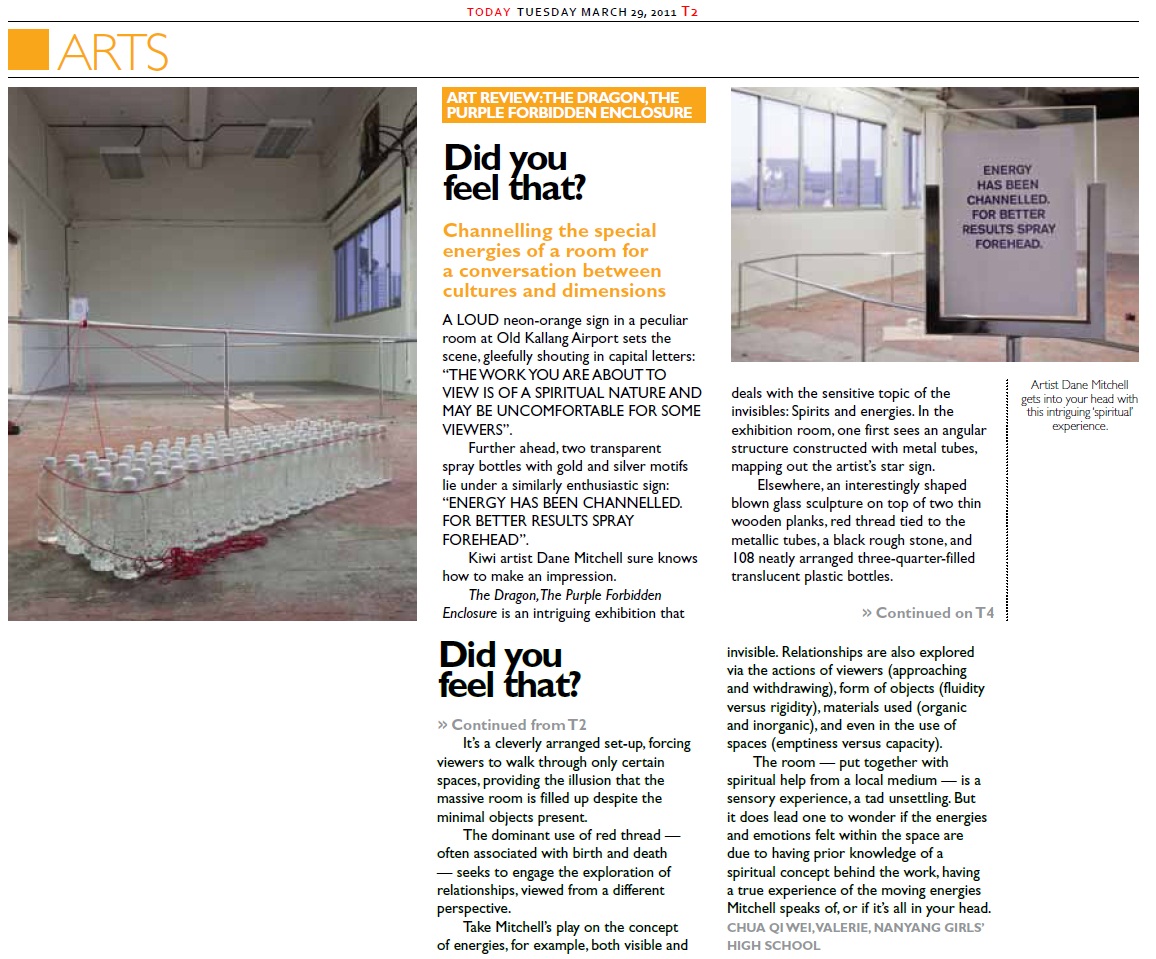
One stumbles upon the loud neon-orange label next to the wall text shouting “THE WORK YOU ARE ABOUT TO VIEW IS OF A SPIRITUAL NATURE AND MAY BE UNCOMFORTABLE FOR SOME VIEWERS”, giving the viewers a quick idea of the concept behind the piece. Looking forward, a signboard too screams at the viewers, “ENERGY HAS BEEN CHANNELLED. FOR BETTER RESULTS SPRAY FOREHEAD”. While, beneath it are two transparent spray bottles filled with water and a gold or silver patterned paper in each of it. The Dragon, The Purple Forbidden Enclosure by Dane Mitchell certainly captures the attention of passers-by.

This particularly intriguing work by Mitchell, deals with the sensitive topic of the invisibles- spirits and energies. In the exhibition room, one first sees an angular structure constructed with metal tubes, resembling constellations. An interestingly shaped blown glass sculpture is also placed on top of two thin wooden planks. Looking further, the red thread tied to these metallic tubes, a black rough stone and 108 neatly arranged three-quarters filled translucent plastic bottles is hardly unnoticeable.

Mitchell makes use of a cleverly arranged set-up comprising large empty spaces and a conjoining linear system of metal tubing. Not only are the few main objects given emphasis, it also connects the exhibit from one side to another, giving the viewers a guided walkthrough around it. The metal tubing also fragments larger spaces, forcing viewers to only be able to walk through certain spaces and thus giving one the illusion that the room is full, despite the minimal objects and things present.

Red threads are often commonly associated with birth and death- things different yet seemingly alike. Mitchell’s work allows one to reconsider things from a different perspective, and in this case, with its dominant use of red thread, it seeks to engage the exploration of relationships. An example would be Mitchell’s play on the concept of energies. The visible exhibition set-up being compared against the invisible energies channeled. Despite the two being completely separate things, it is of no denial that they both help in addressing the same concept. Likewise, there is also an interlinked relationship between the movement of energies- arrival and departure. Two completely different extreme points, yet both speak of the same way of continuity in a cycle. In other aspects, relationships are also explored via the actions of viewers (approaching and withdrawal); the form of objects (fluidity versus rigidity); the materials of the objects (organic versus inorganic); and even in the use of spaces (emptiness versus fullness).

A room specially set up, with collaboration from different fields- Mitchell, glass blowers, spiritual mediums- undoubtedly helps create a sensual experience for the onlooker. Be it unsettling, uneasiness or simply being neutral. However so, it still leads one to wonder if such feelings felt within the exhibition room was due to having prior knowledge that there is a spiritual concept behind the work, one’s own imagination, having a true experience of moving energies which Mitchell speaks of, or purely coincidental.